The connective trust layer
for your most important teams.
A private counterpart each person confides in - one that hears every side, repeats none of it, and helps the whole team walk into the hard conversations ready.
Five minutes, start to finish. The gap every team feels, the behavior that already exists, what we're building, why it defends, how big it gets, and why now.
The best teams weren't just better. They had an advantage.
Most teams don't get the same setup.
- Shared trust
- Strong chemistry
- Better reads on each other
- Someone who could help them think under pressure
- Pressure
- Misreads
- Unprocessed tension
- The friction that follows
Then came AI.
The holy grail. The be-all, end-all.
The LLM became the everything machine overnight.
And awareness drowned in the process.
It got close enough to feel like the answer. More context. More summaries. More output. But the core problem remained: too much signal, too little awareness, and almost no traction on what actually mattered. The machine did not solve that problem. It made it easier to ignore.
Everyone now has an LLM.
All of it starving to connect.
Everyone has their own genius now - brilliant, private, sealed in its own box. But a box never talks to the box beside it. The most capable ensemble in history, and not one of them playing in unison.
Brilliance isn't the constraint anymore. Connection is.
And they overshare to it at work.
The co-founder they're done with. The reorg they haven't told the board. The draft that would end a career if they sent it.
The confessional is already built. It just isn't built to turn confession into clarity the room can use. Note takers capture words. Borton surfaces the human context underneath.
The connective trust layer.
It starts as the coach you'd never let anyone overhear. It becomes the layer every working relationship runs through.
One job. Take what's actually in your head, weave it with the context already around it, and turn it into something the room can use.
The conditions are set.
The behavior exists. The buyers exist. The incumbents aren't built for it.
The behavior already exists
Leaders already confide in AI. They already paste in the raw thing. The product just has to be the one worth keeping open.
Software beats coaching on speed
Companies buy software in a week. They commit to executive coaching in a quarter. Most hard conversations don't wait.
No category owner yet
General-purpose chat optimizes for breadth. Incumbents can't pivot into this without redesigning themselves. We optimize for the hardest ten minutes of your week.
Individual first. Team second. Infrastructure third.
Win the leader. Earn the team. Become the rail the organization routes hard thinking through.
Enter at market
High-trust operators. Founders, senior ICs, directors at complex orgs. Private utility sells itself. Entry at ~$20/seat/month - anchored where individual AI already gets paid.
Land and expand
Seats expand into the function. Packaging starts to earn: tiered access, team modules, shared context. ARPU climbs because the product earned the expansion, not because pricing got aggressive.
System of record
Alongside Snowflake (numbers), Workday (HR), Salesforce (customer). Borton for human signal. Platform pricing, enterprise tiers, add-on modules - ARPU peaks here once the footprint justifies it.
Pricing anchors where individual AI already gets paid - ~$20/seat/month at entry. ARPU grows through land-expand, packaging, and add-on modules once footprint is earned. Comparables: Superhuman and Linear on per-seat dynamics, Gong on narrower capture, Snowflake on category frame. Numbers illustrative pending validation.
And it's already
everywhere you work.
Borton isn't another app you have to remember to open. It lives where your team already runs - and that does two jobs at once.
It reads the room without being told. The thread, the tone, the history - already there, so you never start from scratch.
And it kills the friction of feeding it. Six minutes after your 1:1, Borton pings you in Slack: "Two verbs and a noun - how'd it land?" You answer in five seconds. "Got it. That's all." It books the six-minute session; it pulls the thread for tone.
The hard conversation is why you buy it. Everywhere is why it never leaves.
If you know the room, you already know the problem.
Looking for the operators, builders, and investors who see what happens upstream of a bad meeting - and want to fix it there. Reply, introduce, or come build it with us.
Reply to this memo Back to heyborton.comThe rest is here,
when you want it.
You have the shape of it. Below, in whatever order you like: proof it already works, the architecture that defends it, and how it actually runs.
It already works.
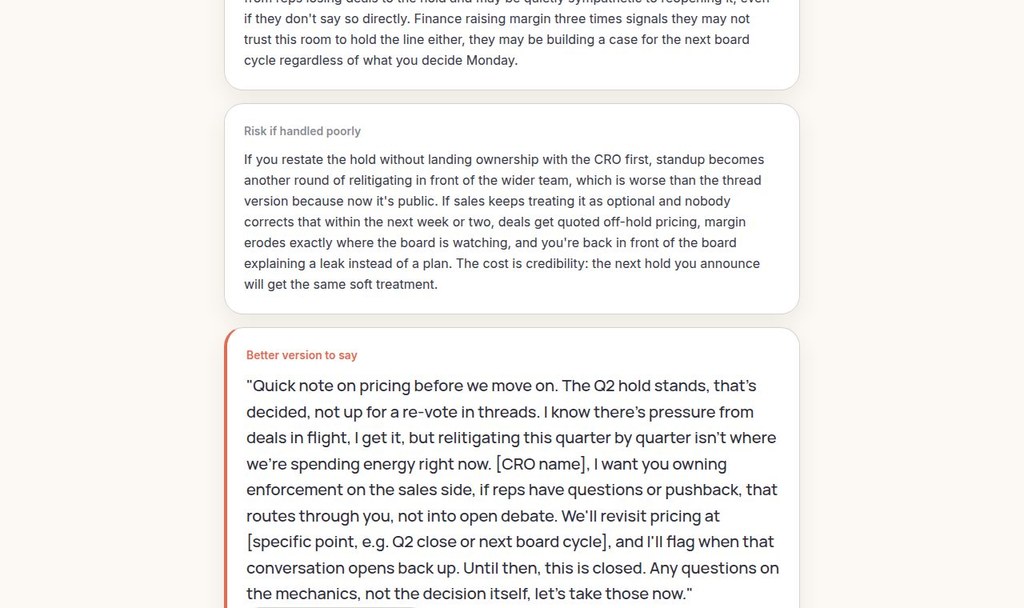
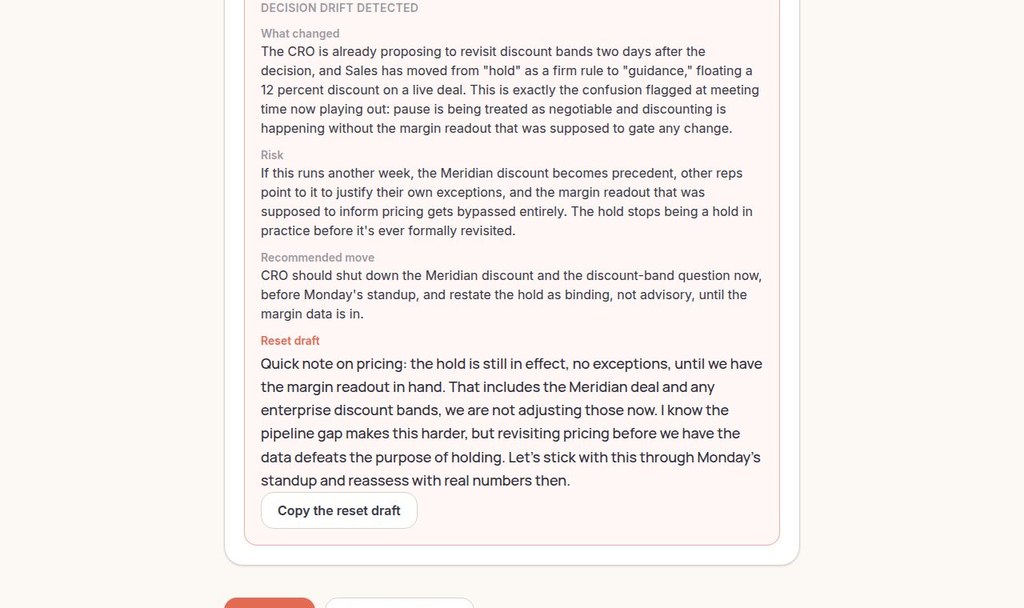
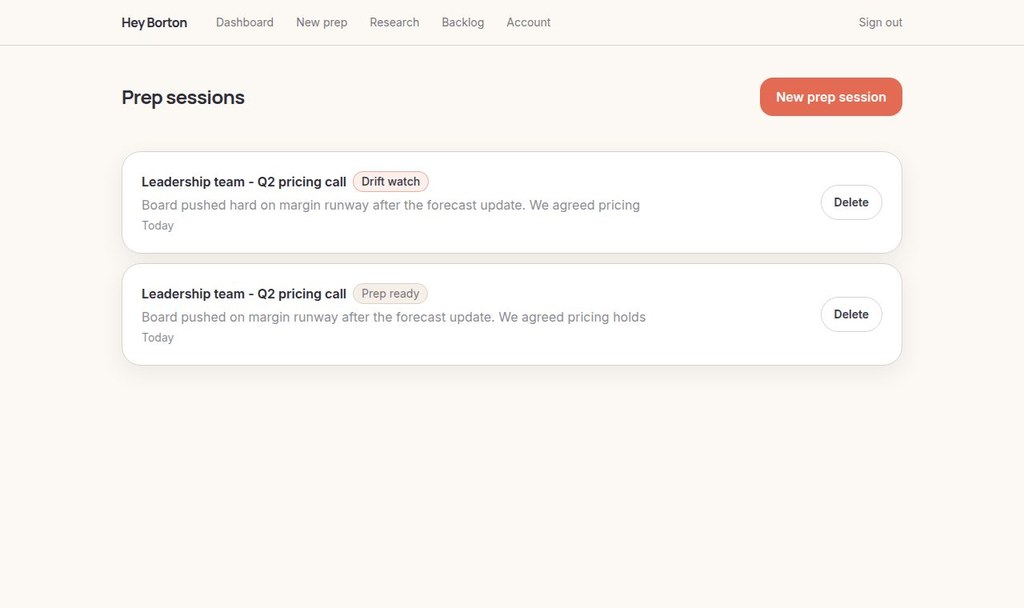
The real product, shipping today. Prep before the room, the exact words to say, and the drift caught after - on one leader's Q2 pricing call.
Private in the spoke. Useful in the hub.
Never a snitch.
Three rules. Non-negotiable. By architecture, not by policy.
The spoke is yours
What you say stays in your session. Not your boss. Not your CEO. Not us.
The hub learns shape, not content
Patterns of friction, alignment, and timing across the org. Raw input never leaves the spoke.
Never a snitch
Borton never reports, quotes, or attributes. Defensibility follows: leaders keep processing privately, the hub keeps learning the shape of organizational friction, and no one else can replicate that without redesigning their trust model from scratch.
The sharpest objection: "So it's nudging me based on things people said about me that I can't see?" Two answers. Everyone confides, and everyone benefits - the same layer that helps Dave notice a pattern also helps Maya. And Borton never forwards private context, quotes one leader to another, or exposes who said what. It carries context forward, not attribution. It surfaces the question you needed anyway.
Snowflake holds your numbers. Borton holds your humans. Both are required to run a company.
One leader reads the signal between them.
Say the raw thing. Read what it's signaling - and what they may be signaling back. The real tension usually lives in the gap between the two.
Before the room. In the room. After the room.
The leader gets clearer. The team inherits the clarity.
Not a coach. Not a notetaker.
The connective trust layer.
A category the incumbents cannot pivot into without redesigning their trust model.
They answer questions.
Borton holds the room. General-purpose chat optimizes for breadth. We optimize for the hardest ten minutes of your week.
Great because of the layer.
The best coach knew what everyone thought about everyone. That was the edge - and it was slow, expensive, C-suite only. Borton is the layer itself, always open.
They capture words.
Borton surfaces the human context underneath them. Expectations, sensitivities, pressures, what is going unsaid.
Good people still miss each other. Real communication needs context.
People talk all the time. Borton gives them more of what understanding actually needs before the conversation starts - context, timing, and a clearer sense of what matters.
When people understand more, they do better.
Not to game the room. To make the room better.